Bovada

Dragon Tiger: Rules, Demo, Live Dealer and Real Money Play Explained

Reviewed and updated: February 2026 · Editorial review: Nisha Rao, Content Editor at Casino and Betting India (10+ years covering live casino products, payment rails and bonus compliance for Indian players)

"Before you deposit, check the withdrawal rules, payment friction, and actual house edge. Dragon Tiger is fast and simple, but clarity on bonus terms and payout structures must always come before placing your first bet." Nisha Rao, Content Editor at Casino and Betting India

Provider

Ezugi

RTP

96.27%

Volatility

High

Min bet

0.20

Max bet

100

Dragon Tiger Rules, Demo, Live Dealer
Table of ContentCloseOpen
Dragon Tiger in 60 Seconds

Dragon Tiger in 60 Seconds

  • The game:one card to Dragon, one card to Tiger, higher rank wins. Ace = 1 (lowest), King = 13 (highest). No drawing rules, no decisions after the deal.
  • The odds:Dragon and Tiger each win 46.26% of rounds in an eight-deck shoe; 7.47% of rounds end in a tie. Main bets carry a 3.73% house edge with a 50% tie refund, and 7.47% if your table offers no refund at all.
  • The trap:the Tie bet at 8:1 carries a 32.77% house edge. Side bets are where bankrolls die.
  • The formats:demo (zero risk), online RNG (120 to 150 hands per hour), live dealer (30 to 40 hands per hour). Speed, not stake size, is what drains a balance.
  • For India:a 28% GST applies to real-money deposits and chip purchases, table games usually contribute only 0% to 10% toward bonus rollover, and several states prohibit online real-money gaming outright.
  • The verdict:Dragon Tiger is entertainment with a fixed mathematical cost. No system removes the edge. Only bet selection, session limits and format choice change how fast you pay it.
Who This Guide Is For, and

Who This Guide Is For, and What It Will Not Promise

Most people reach this page after one of three searches: what is dragon tiger, dragon tiger demo, or dragon tiger real money. Different questions, same underlying worry. Is this safe, is it allowed where I live, and will I actually get my money back out?

So this guide answers in that order. Rules first, because you cannot judge risk in a game you do not understand. Then formats, including the free dragon tiger demo, because practising costs nothing. Then the India-specific layer: the 28% deposit levy, UPI and NetBanking realities, KYC paperwork, state-level restrictions, and the bonus weighting clauses that quietly exclude table games.

What you will not find here is a winning system. Dragon Tiger has a fixed house edge, and no staking pattern touches it. What you can control is which bets you place, how fast you place them, and when you stop.

That is the whole toolkit. Honest? Yes. Exciting? Less so. But it is the version that keeps a bankroll alive.

One more framing note. Treat every rupee here as spent on entertainment, the way you would treat a cinema ticket. If you are reading this hoping for income, this is the wrong page.

What is the Dragon Tiger Game and What Are Its Features?

Dragon Tiger is a minimalist two-card comparison casino game where one card is dealt to the Dragon position and one to the Tiger position, with the highest card rank winning the round. It originated in Asian land-based casinos and is now widespread online. The game is defined by ultra-fast gameplay, symmetric odds, and a single decision per round.

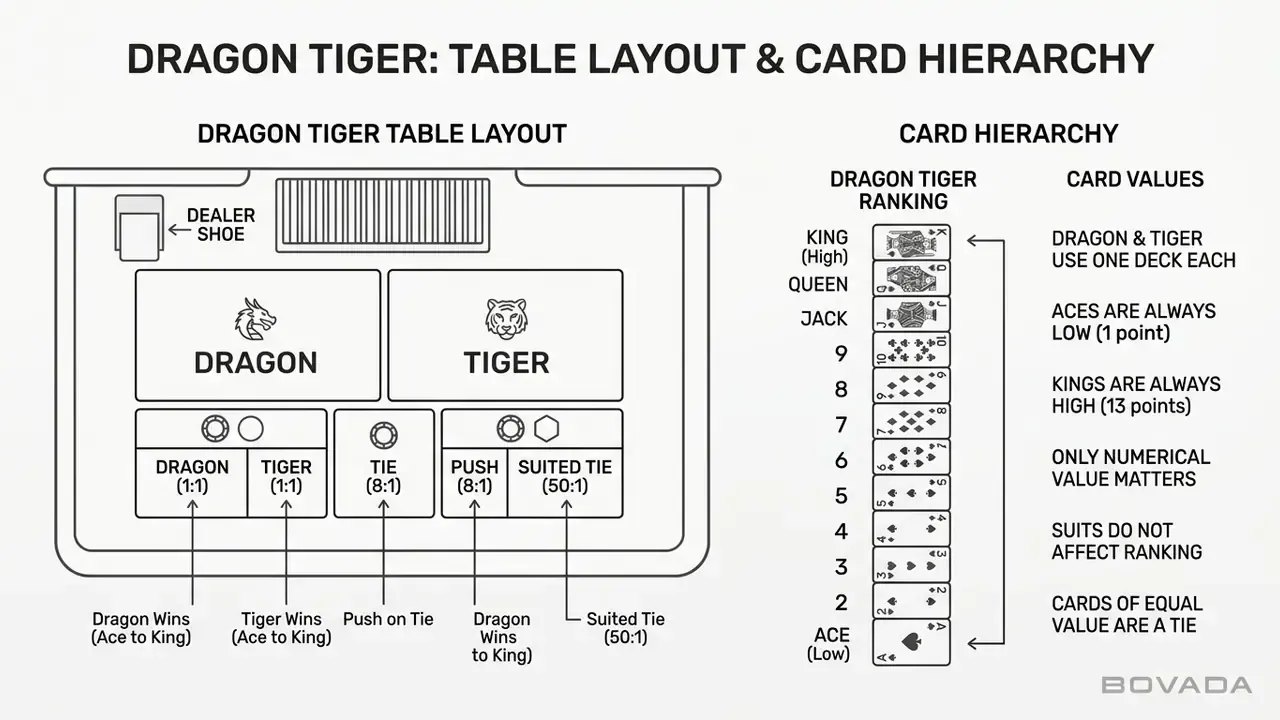
Dragon Tiger layout showing Ace-low to King-high single-card comparison

In standard implementations documented by mathematical analysts, the dragon tiger game uses a shoe containing six to eight 52-card decks. Cards follow standard poker rankings, with one critical difference: Ace is always the lowest card (worth 1 point), while King is the highest (worth 13 points).

Unlike complex casino games that require multi-stage decisions or drawing rules, the key game features of Dragon Tiger focus on total simplicity and speed:

Bovada heading-banner
  • Two-card deal:exactly one card goes to Dragon and one to Tiger.
  • Instant resolution:no additional cards are drawn under any circumstances.
  • Symmetric odds:the main bets on Dragon or Tiger offer identical winning probabilities (46.26% each in an eight-deck shoe, with a 7.47% chance of a tie).
  • Fast decision cycles:rounds take seconds, which makes it one of the quickest table games in any dragon tiger casino.

«Dragon and Tiger each win 46.26% of hands; the house retains 3.73% of the amount wagered on the main positions.» Wizard of Odds, Dragon Tiger mathematical analysis (2026). https://wizardofodds.com/games/dragon-tiger/

The arithmetic behind that figure is

The arithmetic behind that figure is easy to verify yourself. In an eight-deck (416-card) shoe there are 1,326 equally likely two-card combinations by rank distribution; 624 of them favour Dragon, 624 favour Tiger, and the remainder produce identical ranks. That balance is exactly why symmetric main bets and a comparatively rare tie define the risk profile of the whole game.

Worth adding a small note on why the game travelled so well to Indian mobile lobbies: there is nothing to memorise. No third-card table, no split decisions, no side-strategy debates. You back a side, the cards land, and the round is over in roughly eight seconds. That accessibility is a genuine feature, and also the reason session length needs watching.

Dragon Tiger and Baccarat Similarities in

Dragon Tiger and Baccarat: Similarities in Game Format

Dragon Tiger and classic baccarat both compare hands dealt to two opposing sides, Dragon/Tiger versus Player/Banker, without requiring any player decision after the cards appear. However, Dragon Tiger deals only a single card per side, whereas classic baccarat deals two or three cards per hand using fixed drawing rules.

In classic baccarat, point totals are calculated modulo 10 (10s and face cards count as 0), and the total closest to 9 wins. Standard Dragon Tiger, by contrast, uses direct single-card rank values from Ace = 1 through King = 13. Simpler, faster, and slightly more expensive per hand.

It is worth noting that regulated land-based operators also offer hybrid variants. The Gambling Regulatory Authority of Singapore, for example, defines "Dragon Tiger Baccarat" as a specific wagering framework inside traditional multi-card baccarat rather than the standalone one-card game. When playing standalone dragon tiger online, though, the game is strictly a one-card comparison, and that is the version Indian players will meet in virtually every online lobby.

Hybrid Variant Dragon Tiger Baccarat Rules

Hybrid Variant: Dragon Tiger Baccarat Rules

Unlike single-card standalone games, hybrid variants (such as those featured in resort casinos including Hoiana in Vietnam) combine baccarat's multi-card drawing rules with specialised Dragon and Tiger proposition bets:
  • Core deal:four initial cards are dealt alternately, two to Player and two to Banker. Third-card draws occur automatically according to the standard Baccarat Table of Play, a maximum of three cards per hand is possible, and the higher final total wins.
  • Naturals:if the first two cards on either side total 8 or 9, the hand is a "Natural" and no further cards are drawn.
  • Small Dragon / Small Tiger bets:wagers that win if the Player (Small Dragon) or Banker (Small Tiger) side wins specifically on a two-card total of 7 points, without drawing a third card.
  • Big Dragon / Big Tiger bets:wagers that win when the corresponding side wins on a natural 8 or 9, or through specific qualifying three-card combinations.
  • Player Pair / Banker Pair:settled purely on the initial four cards. A pair of identical rank on the chosen side wins, regardless of the final hand outcome.
  • Tie:if both totals are equal, Player and Banker wagers neither win nor lose, and the Tie wager is paid.

Because hybrid paytables vary by property, always read the printed Table of Play at the table, or the provider help file online, before betting. The proposition bets above are structurally similar to online side bets: attractive payouts, materially worse expected value than the base wager.

Dragon Tiger Rules How Bets and

Dragon Tiger Rules: How Bets and Gameplay Work

The fundamental dragon tiger rules say that players place a bet on whether the dragon or tiger position will receive the higher-ranked card, or whether both cards will tie. Once betting closes, two cards are dealt face up, and winning wagers are paid immediately according to the game paytable. Suits are irrelevant to the main comparison; they matter only for the Suited Tie side bet.

  1. Select your bet: place chips on Dragon, Tiger, or optional side bets (Tie, Big/Small, Suited Tie) before the betting timer expires.
  2. Card deal: the dealer or RNG system deals one face-up card to the Dragon box and one face-up card to the Tiger box.
  3. Rank comparison: card values run from Ace (lowest) to King (highest). Suits do not affect the main hand comparison.
  4. Outcome resolution:
    • if Dragon is higher, Dragon bets win at 1:1 and Tiger bets lose;
    • if Tiger is higher, Tiger bets win at 1:1 and Dragon bets lose;
    • if both cards share equal rank, Tie bets win, while main Dragon and Tiger bets lose 50% of the wagered amount.
  5. Payout and reset: winnings are credited, losing chips are collected, and the table resets for the next round.

Figure 1: step-by-step sequence of a standard Dragon Tiger round.

Note the one rule that separates a fair table from an expensive one: tie handling. Land-based operators in India commonly return 50% of the main stake on a tie and pay the Tie wager at 10:1 or 11:1, while some online variants pay Tie at only 8:1. Both details change your expected cost per hour, and neither is advertised on the lobby thumbnail.

What You Can Bet on in Dragon Tiger

Players can place a main bet on either Dragon or Tiger at 1:1 odds, or wager on proposition side bets such as Tie, Suited Tie, Big/Small, or Odd/Even. Main hand wagers carry a competitive 3.73% house edge. Proposition side bets carry edges that can exceed 30%.

Bet TypeWinning ConditionStandard PayoutTheoretical House Edge (8 Decks)
DragonDragon card rank is higher than Tiger1:1 (loses 50% on Tie)3.73%
TigerTiger card rank is higher than Dragon1:1 (loses 50% on Tie)3.73%
TieDragon and Tiger cards have equal rank8:1 or 11:1 (provider dependent)32.77% (at 8:1) / 10.36% (at 11:1)
Suited TieEqual rank AND equal suit50:1~13.98%
Big / SmallChosen side is Big (8 to K) or Small (A to 6); a 7 loses1:17.69%
Odd / EvenChosen side's card rank is odd or even1:1~3.73% to 7.69% (paytable dependent)

Fact check and rule verification Always confirm the specific paytable and tie-refund rules before placing a bet. In some casino variants a Tie outcome means a 100% loss on main bets instead of a 50% refund, which pushes the main house edge from 3.73% up to 7.47%, double the cost per wagered rupee. Verify official game specifications through the provider's help file or the regulator's published rule sheet, not through a review summary.

How to Play Dragon Tiger Online

To play dragon tiger online, players use either computer-simulated Random Number Generator (RNG) software or high-definition live dealer streams on licensed casino platforms. Online availability means Indian users can reach the game around the clock through mobile browsers or dedicated apps, funded with local payment methods such as UPI and NetBanking.

When choosing how to play dragon tiger, start from your objective. Testing mechanics with zero exposure, chasing fast automated rounds, or wanting the atmosphere of a real casino floor are three different goals, and they point to three different formats.

Dragon Tiger Demo for Getting Acquainted

Dragon Tiger Demo for Getting Acquainted with the Game

A dragon tiger demo gives you a virtual-credit environment where you can practise betting layouts, test the interface, and learn the mechanics with no financial exposure. Virtual demo funds behave exactly like a real balance during play, yet carry no monetary value and cannot be withdrawn as real money.

Using a free demo mode lets you verify how a specific software developer implements side bets, tie refunds, and roadmap statistics such as Big Road or Bead Plate tracking. Think of it as a practical, risk-free rehearsal before any real-money decision.

Modern RNG and "first-person" builds add control features that most players overlook, and they are precisely the tools that make demo practice statistically useful:

  1. Free hand generation: a dedicated button deals hands without placing wagers, so you can build trend roadmaps instantly and test pattern-recognition assumptions at zero cost. This is the fastest way to prove to yourself that streaks look meaningful yet predict nothing.
  2. Manual shoe reshuffling: you can reset the six- or eight-deck shoe at any moment, which allows clean-condition tests of flat betting or bankroll survival without waiting for the shoe to run out.
  3. "Go Live" portal: several providers place a live-table shortcut inside the RNG interface. Treat it as a risk boundary rather than a convenience. Crossing it moves you from virtual credits to a real INR balance in one tap.

Do you need an account for demo mode? Most provider showcase pages and casino lobbies allow demo play after a simple 18+ age confirmation, with no KYC and no deposit. Some licensed operators do restrict demo access until registration, and free-play mode can also be blocked in certain jurisdictions by IP filtering. If a "practice" table asks for card details, close it. Genuine demo modes never require payment credentials.

Dragon Tiger Live Dealer and Live

Dragon Tiger Live Dealer and Live Casino

In a dragon tiger live dealer setting, a professional human dealer handles physical cards in a real-time broadcast studio, combining authentic table atmosphere with a digital betting interface. Dragon tiger live casino titles usually include live chat, multi-angle HD streaming, and historical scorecards. Regulated live-dealer operations also require trained and supervised croupiers, video recording of the table, and commercial-grade equipment under access control. That is a meaningful integrity difference from unlicensed streams, and it is rarely visible in the lobby.

Some studios layer feature mechanics on top of the base game. Multiplier variants, for instance, randomly select a suit and a multiplier (commonly 2x to 8x) after betting closes, then pay enhanced returns when the winning card matches. These features are funded by an increased base cost, so the bigger payout does not translate into a lower house edge. Nice to watch. Not cheaper.

Feature / ParameterDragon Tiger DemoOnline RNG Dragon TigerDragon Tiger Live Dealer
Primary purposePractice and rule evaluationFast automated real-money playAuthentic studio experience
Financial riskZero (virtual credits)Real money (INR / UPI)Real money (INR / UPI)
Round speedUser-paced or fast (~150 hands/hr)Ultra-fast (120 to 150 hands/hr)Moderate (30 to 40 hands/hr)
Dealer interactionNone (automated graphics)None (automated software)Real human dealer via live chat
Minimum stakesFreeVery low (e.g. ₹10 to ₹50)Low to medium (e.g. ₹50 to ₹500)
Bonus eligibilityNot applicableLimited (check T&Cs)Highly restricted (0% to 10% rollover)

Table 1: comparison of Dragon Tiger game formats.

As Table 1 shows, online RNG formats run up to four times faster than live dealer tables. Industrial tracking data indicates that faster rounds accelerate hourly monetary exposure:

«Flat-betting $5 per hand produces expected losses of $50.36/hour on RNG versus $13.06/hour with a live dealer.» Betting Data Lab, Dragon Tiger Online vs Live Casino: Which Format Actually Wins (2026). https://bettingdatalab.com/dragon-tiger-online-vs-live/

The practical takeaway: format choice is a bankroll decision, not an aesthetic one. Identical stakes and an identical house edge can still cost nearly four times more per hour, purely because of round throughput.

How to Read Dragon Tiger Roadmaps

How to Read Dragon Tiger Roadmaps (Scorecards)

Live dealer and modern RNG games display dynamic scorecards, or roadmaps, that show historical outcome patterns across the current shoe. Understanding them prevents the most common beginner error: mistaking a record of history for a forecast.
  • Bead Plate:shows exact historical outcomes in sequence, filling from top-left downward and then moving to the next column. Red circles mark Dragon wins, blue marks Tiger wins, green marks ties.
  • Big Road:tracks streaks and trend shifts. A new column starts whenever the winning side switches between Dragon and Tiger, while consecutive wins for the same side build downward inside one column, so long vertical runs visualise streaks.
  • Derived roads (Big Eye Boy, Small Road, Cockroach Pig):advanced displays that measure the repetitive consistency of the Big Road rather than outcomes themselves, helping trend bettors judge whether a shoe is "choppy" or "streaky".
  • Statistics panel:most interfaces also show cumulative counts and percentages for Dragon, Tiger, Tie and Suited Tie in the current shoe, plus the number of hands remaining before the shuffle.

Note: roadmaps help you track table history and pace a session, but every dealt hand remains a statistically independent event governed by fixed shoe probabilities. A ten-hand Dragon streak does not change the 46.26% probability attached to the next hand.

Dragon Tiger Strategy: Using Demo and Rules Before Betting

No mathematical dragon tiger strategy alters the fixed house edge built into the game. Focusing exclusively on main bets, and strictly avoiding high-edge side bets, does minimise expected losses. Because rounds resolve purely by random card draws, progressive systems such as Martingale only increase bankroll volatility without improving long-term statistical return.

«At a 3.73% house edge, no betting system changes expected loss, only variance; long-run results are set by the mathematics, not the pattern.» Wizard of Odds, Dragon Tiger mathematical analysis (2026). https://wizardofodds.com/games/dragon-tiger/

QUIZ 3-question self-assessment on bankroll limits
[❓ QUIZ: 3-question self-assessment on bankroll limits and bet selection. Logic: Identifies if player is choosing high-risk side bets or healthy session limits.]
Purpose: Interactive self-check to reinforce responsible play principles.
Semantics: section role="form" with accessible fieldsets and clear advice.

To protect a bankroll, five habits matter more than any staking pattern:

  1. Stick to main bets. Wagering on Dragon or Tiger keeps you at a modest 3.73% house edge.
  2. Avoid the tie trap. The Tie bet's 8:1 payout hides a 32.77% edge, burning through a bankroll almost nine times faster than main bets.
  3. Verify the tie refund. A table without the 50% refund doubles your main-bet cost from 3.73% to 7.47%. Check before you sit down, not after.
  4. Prefer slower formats when the budget is tight. Live tables at 30 to 40 hands per hour cost far less per hour than RNG tables at 120 to 150.
  5. Set loss and time limits. Decide your walk-away points before placing your first bet, while your judgement is still cold.

Bankroll and Session Limit Checklist

Use this simple formula before the session, not during it:

StepRule of ThumbWorked Example (₹5,000 monthly entertainment budget)
1. Set a monthly ceilingOnly money you can lose without impact₹5,000
2. Split into sessionsDivide by planned sessions per month5 sessions, so ₹1,000 per session
3. Cap the base unit1% to 2% of session bankroll₹10 to ₹20 per hand
4. Stop-loss50% of session bankrollStop at minus ₹500
5. Win goal30% to 50% of session bankrollCash out at plus ₹300 to ₹500
6. Time limit30 to 45 minutes, timer on the phoneHard stop, regardless of result
7. Never re-depositOne deposit per session, no exceptionsNot applicable

Step 1 must account for deposit taxation in India, covered in the GST section below. A ₹5,000 monthly budget converts into roughly ₹3,906 of playable balance once the 28% levy on deposit value is applied. Small detail, real consequence for your unit size.

Why Dragon Tiger Demo is Useful

Why Dragon Tiger Demo is Useful Before Money Play

Testing ideas in a dragon tiger demo environment lets you experience variance honestly, rehearse bankroll management, and watch the high house edge of side bets bite, all without losing real rupees.

Logging demo rounds gives empirical proof of how quickly a balance swings during winning and losing runs. As a practical benchmark, record at least 100 to 200 hands per test. That is enough to meet several streaks of four or more identical outcomes, though nowhere near enough to demonstrate long-run expected value, which needs tens of thousands of hands. Treat the exercise as a discipline drill and a variance demonstration, not as statistical proof of a system. Regulatory technical standards make the same logic explicit for operators: testing must be completed before release.

The same principle applies to a player validating a staking rule before risking real INR.

Recording rounds also builds discipline around stop-loss rules and session timing, so the eventual move to real-money play happens with realistic expectations. The behavioural stakes are not hypothetical:

«Among table-game players who gamble monthly, 50.1% report moderate or high risk, versus 16.4% of less frequent players.» NSW Gambling Survey 2024, Responsible Gambling NSW. https://www.responsiblegambling.nsw.gov.au/research-and-resources/gambling-survey-nsw

Practical demo protocol:

  1. Set a virtual balance equal to your real intended session bankroll, not the maximum the demo hands you.
  2. Use free hand generation to build 50 hands of roadmap history before betting a single virtual chip.
  3. Play 100 to 200 flat-bet hands, recording peak balance, lowest balance and end balance.
  4. Use manual shoe reshuffling and repeat under clean conditions to compare outcomes.
  5. Repeat once with side bets included. The drawdown difference is usually the most persuasive argument against them.

Dragon Tiger Real Money: Access, Tax, Payments and Bonus Terms

Disclaimer: this information is general in nature and does not replace professional legal, tax or financial advice. Online gambling is governed by the law of your jurisdiction; confirm that participation is lawful for you before making any deposit.

Before any dragon tiger real money play, evaluate operator licensing, payment security, minimum withdrawal limits, taxation on deposits, and the wagering contribution rate for table games. Most online casino welcome packages apply strict wagering requirements that heavily discount, or completely exclude, table games.

«Inducement offers increased bet sizes by more than 10% and tripled the likelihood of decision errors.» Effects of inducements on sports gambling and decision-errors (2024/2025). https://doi.org/10.1016/j.addbeh.2024.inducements

⚠️ Tax and deposit warning for players in India (28% GST)

In accordance with Notification No. 51/2023, issued by the Ministry of Finance (Department of Revenue, Central Board of Indirect Taxes and Customs) and effective 1 October 2023, a 28% Goods and Services Tax applies to the amount paid for the purchase of chips, playing coupons and real-money gaming deposits.

  • Non-refundable: GST paid at the time of deposit or chip purchase is not returned when chips are encashed or a balance is withdrawn.
  • Net bankroll impact: a ₹1,000 payment converts to roughly ₹781.25 of playable balance once the 28% levy on face value applies. Build this entry cost into your bankroll plan before calculating unit size.
  • Winnings are taxed separately: GST on deposits is distinct from income tax withheld on net winnings. Keep transaction records for filing.
Legal Status and State-Level Restrictions in
Indian online gaming sits inside an evolving framework shaped by the Promotion and Regulation of Online Gaming Act and by state-level acts. Understanding online gambling in India means reading two layers at once:
  • Central layer:national legislation plus RBI and payment-processor policy determine which categories of online real-money gaming may be offered, and how funds can move.
  • State layer:gaming is a state subject. Several states, including Andhra Pradesh, Telangana, Tamil Nadu, Assam, Odisha, Nagaland (for certain formats) and Sikkim (with its own licensing regime), have enacted prohibitions or restrictive regimes covering online real-money games. Enforcement includes payment blocking and site-level restrictions.
  • Games of skill versus games of chance:Indian jurisprudence draws a line between the two, and Dragon Tiger is unambiguously a game of chance, since there is no player decision after the deal. It therefore does not benefit from the skill-game exemptions that some other titles claim.
  • Practical implication:residency, not server location, determines your exposure. Check your state's current position before depositing, and expect KYC checks that record your address.

Users must comply with local regulation and should confirm that a platform enforces strict KYC and 18+ player protection measures. If a site is vague about either, that vagueness is the answer.

Payments, KYC and Withdrawals for Indian Players

Payment friction, not game rules, is where most Indian complaints begin. Use the table below as a pre-deposit reference; exact limits are operator-specific and change often.

MethodTypical Deposit SpeedTypical Withdrawal SpeedCommon LimitsNotes for Indian Users
UPI (GPay / PhonePe / Paytm UPI)InstantOften unsupported for payouts; 2 to 24 hrs where available₹100 to ₹100,000 per transactionMost popular deposit rail; some banks decline gaming-coded merchants
NetBanking / IMPS5 to 30 minutes24 to 72 hours after approval₹500 to ₹200,000Beneficiary name must match the KYC name exactly
e-Wallets (Skrill, Neteller, AstroPay)Instant2 to 24 hours₹500 to ₹500,000Fastest payouts; wallet-to-bank transfer adds a step and possible FX cost
Bank transfer (RTGS/NEFT)1 to 4 hours2 to 5 business daysHigh ceilingsBest for large withdrawals; slowest cycle
Crypto (where offered)10 to 60 minutes1 to 6 hoursOperator-definedAdds price volatility plus extra compliance and tax questions
KYC documents to prepare before your

KYC documents to prepare before your first withdrawal request:

  1. Government photo ID (Aadhaar, passport or driving licence).
  2. PAN card, commonly required for tax withholding on winnings.
  3. Address proof dated within the last three months, such as a utility bill or bank statement.
  4. Proof of the payment instrument used for the deposit: masked card image, UPI ID screenshot or bank statement header.
  5. Selfie or liveness verification, if requested.

Why withdrawals get delayed, the five usual causes:

  • Name mismatch between the casino account, the KYC document and the bank or UPI beneficiary.
  • Incomplete verification submitted only after the withdrawal request instead of before it.
  • Active bonus balance locking funds until rollover completes.
  • Closed-loop payment rules requiring the payout to return to the deposit method.
  • Minimum withdrawal thresholds and per-day or per-week payout caps buried deep in the terms.

Editorial tip: finish KYC immediately after registration, then request a small test withdrawal near the minimum before playing at meaningful stakes. A platform that pays ₹500 cleanly within 24 hours is a platform that will probably pay ₹50,000.

Bonus Terms: The Real Cost of "Free" Money

Critical bonus and compliance warning

  • Wagering weighting: table and live casino games often contribute only 0% to 10% toward rollover. A 10% contribution rate effectively turns a 30x wagering requirement into a 300x requirement for Dragon Tiger players, which is mathematically unachievable for most bankrolls.
  • Betting caps: active bonuses usually restrict maximum bet size, for example ₹500 per hand. Exceeding the cap can void bonus funds and any winnings attached to them.
  • Excluded games: many operators exclude Dragon Tiger and other low-volatility, near-even-money table games entirely, because betting both sides can neutralise variance.
  • Regulatory context in India: confirm that the operator enforces KYC, self-exclusion tools and 18+ verification, and that its licence (MGA, Curaçao, UKGC or equivalent) is verifiable on the regulator's own website, not merely displayed as a logo.

Interface design compounds the effect of bonus incentives:

«Online casinos use countdown timers, autoplay and personalised win messages to increase engagement and user spending.» Medendorp, Strategies used by online gambling websites to influence user behaviour (master's thesis, Netherlands, 2024). https://studenttheses.uu.nl/handle/20.500.12932/medendorp2024

Practical countermeasure disable autoplay, switch off

Practical countermeasure: disable autoplay, switch off promotional push notifications, and never accept a bonus you have not read to the end. Specifically the game-weighting table and the maximum-bet clause. Those two paragraphs decide whether the offer is usable at all.

Editorial case example (methodology, updated): In our editorial review conducted between September and December 2025, our team assessed the published terms and conditions of 15 India-facing casino platforms offering live or RNG Dragon Tiger. The method was documentary rather than experimental. For each operator we recorded (a) the stated game-weighting percentage for live and table games, (b) the maximum permitted bet under an active bonus, (c) explicitly excluded titles, and (d) the stated minimum withdrawal and payout timeframe. Across that sample, 12 of 15 welcome offers (80%) either excluded Dragon Tiger from rollover entirely or weighted it at 0% to 10%. In plain terms, players who accepted the bonus and then played Dragon Tiger would have locked their own deposit behind requirements they could not realistically clear. We publish weighting tables in our reviews for exactly that reason. The sample reflects terms current at the time of review, and operators revise T&Cs frequently, so verify the live document before depositing.

Other Casino Games for Dragon Tiger Fans

Players who enjoy the simple mechanics and rapid execution of Dragon Tiger often like other streamlined card and table games in online casinos. The category itself keeps expanding:

«Interactive table game revenue rose from $525 million to $597 million (+13.6%) in fiscal year 2024/2025.» Pennsylvania Gaming Control Board, Annual Report FY 2024/2025. https://gamingcontrolboard.pa.gov/files/revenue/Annual_Report_FY2024-25.pdf

Bovada heading-banner
  • Baccarat:the direct ancestor of Dragon Tiger, offering a lower house edge on Banker bets (1.06%) with structured two- and three-card drawing rules.
  • Andar Bahar:a traditional Indian card game where players bet on whether a matching rank will land on the Andar (inside) or Bahar (outside) pile.
  • Bac Bo:a live casino creation merging baccarat concepts with dice, using two dice for Player and two for Banker in a fast head-to-head comparison.
  • Football Studio, also sold as Top Card:a sports-themed two-card comparison game matching Home versus Away, sharing the core rules of Dragon Tiger almost exactly.
  • Sic Bo:a three-dice game with a wide betting grid. Small and Big wagers are the low-edge options, while Triple bets carry very high edges.

Dragon Tiger vs Andar Bahar vs Baccarat: Quick Comparison

ParameterDragon TigerAndar BaharBaccarat
Core decisionHigher single card: Dragon or TigerWhich side matches the Joker rank firstPlayer, Banker or Tie
Cards per round2Variable, until a match appears4 to 6
House edge (best bet)3.73% on main bets, with 50% tie refund~2.15% on the favoured side in common live formats1.06% (Banker)
Worst common betTie at 8:1 (32.77%)Side-bet card-count wagers, often above 10%Tie (~14.4%)
Round speed (live)30 to 40 hands/hour40 to 60 rounds/hour25 to 35 hands/hour
Rule complexityMinimal, no drawing rulesMinimal, but round length variesModerate, third-card table applies
Best suited toPlayers wanting the fastest even-money decisionPlayers who prefer a familiar Indian formatPlayers prioritising the lowest house edge

Andar Bahar payouts and commission structures differ noticeably between providers, and some pay 0.9:1 on the favoured side, so check the paytable before comparing edges directly.

FAQ: Dragon Tiger Questions Indian Players Ask

Pre-Deposit Safety Checklist

Run through all ten points before your first real-money round:
1
Licence number verified on the regulator's own website, not just in the casino footer.
2
HTTPS/SSL active on all deposit and account pages.
3
Terms and conditions read for game weighting, maximum bet under bonus and excluded games.
4
Minimum withdrawal amount and payout timeframe located in writing.
5
KYC documents uploaded and approved before depositing.
6
Deposit method name matched exactly to your KYC identity.
7
28% GST factored into your bankroll arithmetic.
8
Your state's legal position on online real-money gaming checked.
9
Deposit limit, loss limit and session-time limit set inside the account tools.
10
Self-exclusion and reality-check tools located, in case you need them later.

Green Flags and Red Flags at a Glance

Green flags worth trustingRed flags worth walking away from
Licence details verifiable on the regulator's siteLicence shown only as an unclickable logo
Game weighting published in a clear tableBonus terms that never mention table games
Test withdrawal paid within the stated windowPayout window described as "up to several weeks"
Deposit, loss and time limits available in settingsNo responsible gambling tools in the account area
Demo tables open with no card details requested"Free play" that asks for payment credentials
Support answers rule questions with paytable referencesSupport pushing a deposit bonus instead of answering

If you find three or more items from the right-hand column, stop there. There is no bonus large enough to compensate for unclear payout terms.

Disclaimers and Responsible Gambling

18+ only. Real-money gambling involves financial risk and possible loss. Dragon Tiger and every other casino game is a form of paid entertainment, not a source of income or financial gain. Set strict deposit limits, use self-exclusion tools when needed, and play responsibly. This guide is informational and does not constitute legal, tax or financial advice; the legality of online gambling varies by Indian state and jurisdiction. If gambling is affecting your finances, work or relationships, contact a licensed counsellor or a national helpline.