Roulette Online: Rules, Bets, Payouts, Live Dealer Tables and Strategy Explained
Last reviewed and updated: January 2026 · Editorial review: Casino and Betting India desk

Last reviewed and updated: January 2026 · Editorial review: Casino and Betting India desk
"Before you deposit a single rupee or select a digital chip, understand that roulette is a game of fixed mathematical probabilities, not predictable patterns. A massive welcome bonus or a slick live dealer interface does not alter the house edge. My goal as an editor is to strip away promotional hype, explain wagering terms and payment friction in India, and give you clear checks to evaluate any roulette table before risking your bankroll." Nisha Rao, Casino Content Editor at Casino and Betting India (editorial persona for this desk)

Most people searching for roulette in India want two answers at once. First: how does the game actually work? Second: what happens to my money once it leaves my bank account?
This guide answers both, in that order. The first half explains the wheel, the layout, bet types and payouts, so you can read any table without guessing. The middle covers deposits, KYC and INR withdrawals, because that is where Indian players hit friction far more often than they hit a bad spin. The last sections cover strategy claims, red flags in casino offers, and the limits you should set before your first real-money round.
One framing note. Roulette play is paid entertainment with a built-in mathematical cost. Nothing here promises income, and no section suggests a way to beat the wheel, because none exists.
What you can control is the variant you choose, the stake size, the pace, and the moment you stop.
Legality also deserves a caveat up front rather than a footnote: India's rules operate at two levels, central and state, and they are still moving. More on that in the payments section.
Roulette is a classic casino game where players bet on which numbered compartment of a spinning wheel a small ball will land in. The outcome of every spin is governed by fixed mathematical odds and by physical or random number generator (RNG) mechanics, which makes each round entirely independent of previous results.
«The probability of red or black on a European wheel stays exactly 18/37 on every spin, regardless of previous results.» Ancient Games, Comparative Analysis of Roulette Variants (2024). https://ancientgames.org/roulette-variants-comparative-analysis/

The physical apparatus has two primary elements: the roulette wheel and the table roulette layout. The wheel contains either 37 numbered pockets (European and French roulette, marked 0 and 1 to 36) or 38 pockets (American roulette, which adds a 00). A handful of land-based venues also run triple-zero wheels. The Venetian in Las Vegas, for example, offers an exclusive table with a third green slot marked with a "V" logo, giving 39 segments and pushing the house edge above 7% on most wagers. That is a format to recognise and walk past, not to seek out.
The betting layout mirrors these numbers in an organised grid, alongside designated sections for group wagers such as red/black, odd/even and dozens. In physical and live dealer setups, a human dealer roulette (croupier) manages the pace, announces the betting window, spins the wheel and settles winning wagers. In standard roulette online games, software automates those tasks while replicating the same statistical distribution as a real wheel.
On a certified single-zero wheel the approved clockwise sequence is 0, 32, 15, 19, 4, 21, 2, 25, 17, 34, 6, 27, 13, 36, 11, 30, 8, 23, 10, 5, 24, 16, 33, 1, 20, 14, 31, 9, 22, 18, 29, 7, 28, 12, 35, 3, 26. The numbers are deliberately non-sequential, so adjacent pockets alternate colour and high or low ranges. That single design choice is exactly why the racetrack, covered in the call bets section below, exists as a separate betting interface.
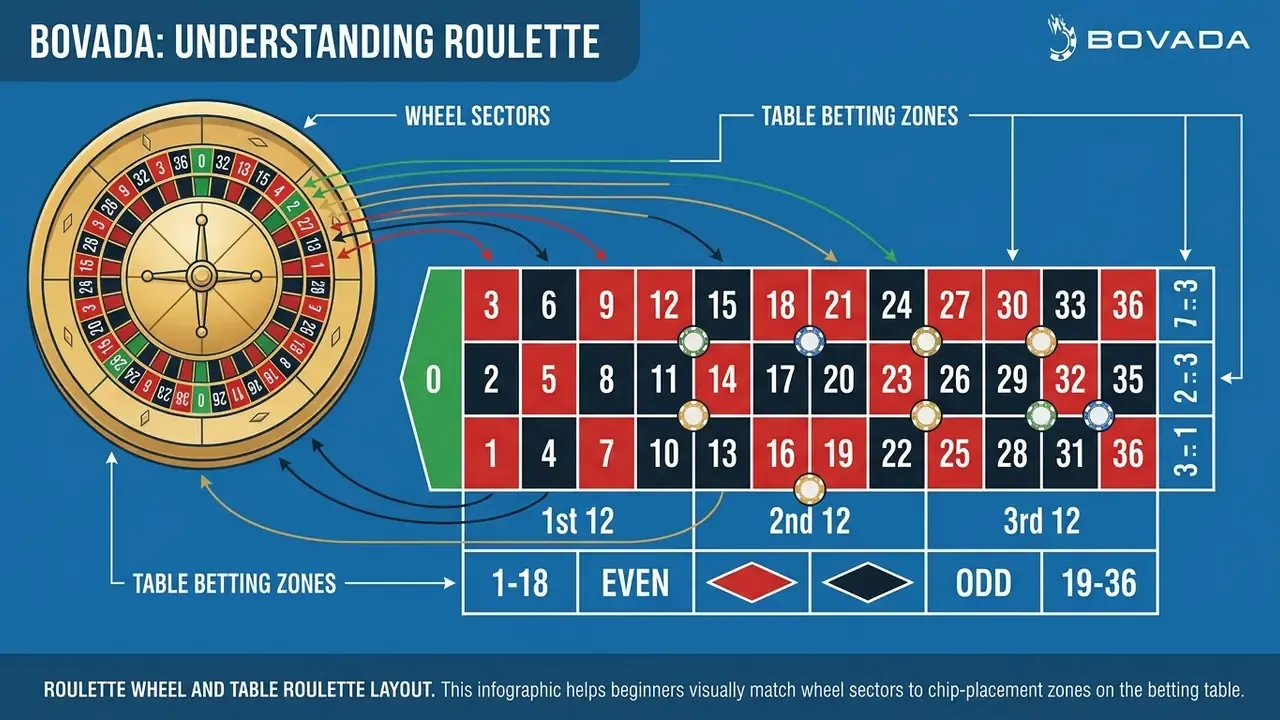

A standard single-zero roulette wheel features 37 compartments: green for the number 0, and the numbers 1 through 36 split evenly between red and black in a prescribed non-sequential arrangement. The table roulette grid is divided into inside betting boxes (individual numbers 0 to 36 arranged in three vertical columns) and outside betting zones along the perimeter.
To place a bet in a casino game, players use specialised gaming chips. In physical casinos, you buy colour-coded non-value chips unique to that specific table, which prevents disputes over ownership. British Columbia Lottery Corporation rules, for instance, state that non-value chips carry monetary value only at the table where they were purchased and must be redeemed there before you leave. In digital roulette online environments, virtual chips are stamped with explicit currency values such as ₹50, ₹100 or ₹1,000. Placing those chips onto the lines or boxes of the digital grid defines the exact bet type and your risk exposure for that round.
«Roulette RTP was verified at 97.30% (July 2023) and 97.08% (April 2024), very close to maximum theoretical expectations.» iTech Labs RTP Audit Reports, Entain Plc (2023 to 2024). https://www.itechlabs.com/certifications/
That audit evidence matters more than it looks. It shows that when a licensed operator runs certified roulette software, the return measured across millions of real rounds lands almost exactly where theory predicts, with no hidden operator margin stacked on top of the published house edge.

A single round, or spin, follows a strict standardised sequence enforced by regulatory frameworks such as the Nevada Gaming Commission, Colorado Gaming Rule 22 and UK Gambling Commission rules:
To start playing roulette online, you select a licensed operator, choose a game variant, set your virtual chip denomination, place bets within table limits, and trigger the spin. The process requires navigating a digital interface where rules, payout tables and limits are all defined before any money is committed.
``` [📋 CHECKLIST: 5 steps for your first roulette online session]

Selecting an appropriate table roulette starts with the posted minimum and maximum limits relative to your session bankroll. Arizona and Colorado gaming rules both require the minimum and maximum wager to be conspicuously posted at each table. Online, the same information sits in the game info panel and on the lobby tile. Once inside the game, pick a chip value worth no more than 1% to 2% of your total balance per spin. Then tap directly on the matching layout box, such as a single number for an inside bet, or "Red/Black" for an outside bet. Digital interfaces add utility controls like "Undo", "Clear All", "Rebet" and "Double Bet", so you can refine placement before pressing "Spin" or letting the live countdown run out.
How we tested this (methodology). Across late 2025 and January 2026 our editorial team opened accounts on India-facing casino platforms and walked through registration, deposit, table selection and withdrawal request flows, recording default chip denominations and posted table limits at each step. This was a qualitative editorial review of publicly available interfaces, not a statistically representative audit, and operator interfaces change often. Treat the observations as directional. The consistent pattern we recorded: players who skip the table-limit panel frequently stake more than intended, because the interface loads with a pre-selected high-denomination chip. Set the chip manually to the table minimum (a ₹10 table behaves very differently from a ₹500 one) before your first wager, and you remove the most common cause of accidental over-exposure.
Table limits define both the minimum stake required to join and the maximum liability an operator will accept on a single position or round. Maximum limits are structured differently for inside and outside bets. A table might allow a ₹10,000 ceiling on Red/Black while capping Straight Up single-number bets at ₹500, simply to contain peak volatility.
«Betting limits block progressive doubling: after nine consecutive losses a Martingale stake reaches ₹51,200 against a typical ₹50,000 ceiling.» Pflaumer, A Statistical Analysis of the Roulette Martingale System (2024). https://www.researchgate.net/publication/378246913
Aggregate payout caps. Some regulated jurisdictions let an operator apply an aggregate payout ceiling per round on high-odds table wagers. The clearest published example is the Iowa Administrative Code, which permits a per-round aggregate payout limit on approved table-game payouts above 50:1, requires that limit to be at least the highest award at the posted minimum bet or $25,000 (whichever is greater), and specifies that where several players win under that ceiling, each receives a pro-rata share. Not every regulator publishes such a rule, so read your own table's posted rules panel. In the end, the payout is decided strictly by the position of your chips at the exact millisecond the ball settles.
🎯 Moving from theory to practice? Casino lists European, French and live dealer roulette with minimum stakes from ₹10. Pick a table that matches your budget, and start in demo mode with no financial risk.
For players in India, the practical friction is rarely the game maths. It is money movement and verification. The table below summarises what to expect from the main payment routes offered by India-facing operators. Timelines are typical operator-published ranges and vary by platform and by your bank.
| Method | Typical deposit min | Deposit speed | Withdrawal speed | Notes for INR players |
|---|---|---|---|---|
| UPI (GPay, PhonePe, Paytm UPI) | ₹100 to ₹500 | Instant | 2 to 24 hours where supported | Most popular route. Bank-level blocks can cause failed transactions, so retry via a different UPI handle |
| NetBanking | ₹300 to ₹1,000 | Instant to 30 min | 1 to 3 business days | Widest bank coverage. Withdrawals need the account name to match your KYC name exactly |
| e-Wallets (Paytm wallet, Skrill, Neteller) | ₹200 to ₹500 | Instant | 12 to 48 hours | Wallet-to-bank transfer adds a step and sometimes a fee |
| Debit and credit cards | ₹500 | Instant | 3 to 5 business days | Some issuers decline gaming merchant codes outright |
| Crypto (USDT, BTC) | Variable | 10 to 60 min | 10 min to 24 hours | No INR conversion at the casino. You absorb exchange-rate and network fees |
KYC in practice. Withdrawals, not deposits, are where verification bites. Complete Know Your Customer checks before you deposit: a government ID (Aadhaar, PAN or passport), proof of address dated within the last three months, and, if you funded by card, a masked card image. Operators usually clear documents within 24 to 72 hours. Payment-name mismatches, meaning a nickname on the casino account and a legal name on the bank account, are the biggest single cause of held withdrawals we see reported.
Tax note. Winnings from online gaming in India are subject to tax deducted at source (TDS) under the applicable provisions of the Income Tax Act, with the deduction generally applied to net winnings at withdrawal. Rates and thresholds change. Consult a qualified tax professional for your situation.
⚖️ Legal disclaimer: India's real-money gaming framework is evolving and operates at two levels: central legislation, including the Promotion and Regulation of Online Gaming Act 2025, and state-specific statutes that restrict or prohibit real-money play in certain states. This article is general information, not legal or financial advice. Verify the current position for your state before depositing.
Wagers in roulette split into two categories. Inside bets sit on individual numbers or small adjacent groups, with lower hit probability and high payouts. Outside bets cover larger groups of 12 to 18 numbers, with higher hit frequency and lower payouts.
| Bet Type | Bet Name | Covered Numbers | Table Placement Zone | European Odds (37 Pockets) | American Odds (38 Pockets) | Payout Ratio |
|---|---|---|---|---|---|---|
| Inside | Straight Up | 1 | Single number box | 2.70% (1/37) | 2.63% (1/38) | 35:1 |
| Inside | Split | 2 | Line between 2 adjacent numbers | 5.41% (2/37) | 5.26% (2/38) | 17:1 |
| Inside | Street | 3 | Outer border of a row of 3 | 8.11% (3/37) | 7.89% (3/38) | 11:1 |
| Inside | Corner / Quarter | 4 | Intersection where 4 boxes meet | 10.81% (4/37) | 10.53% (4/38) | 8:1 |
| Inside | Five Number / Basket | 5 (0-00-1-2-3) | Corner of 0/00 and the 1 to 3 row | n/a (American only) | 13.16% (5/38) | 6:1 ⚠️ |
| Inside | Six Line / Line | 6 | Intersection of 2 rows along border | 16.22% (6/37) | 15.79% (6/38) | 5:1 |
| Outside | Column | 12 | Bottom box of a vertical column | 32.43% (12/37) | 31.58% (12/38) | 2:1 |
| Outside | Dozen | 12 | "1st 12", "2nd 12", "3rd 12" boxes | 32.43% (12/37) | 31.58% (12/38) | 2:1 |
| Outside | Red / Black | 18 | Red or Black diamond box | 48.65% (18/37) | 47.37% (18/38) | 1:1 |
| Outside | Even / Odd | 18 | "Even" or "Odd" box | 48.65% (18/37) | 47.37% (18/38) | 1:1 |
| Outside | High / Low | 18 | "1 to 18" or "19 to 36" box | 48.65% (18/37) | 47.37% (18/38) | 1:1 |
⚠️ Never make this bet: the Five Number (Basket) wager. Available only on American double-zero layouts, one chip covers 0, 00, 1, 2 and 3 and pays 6:1. Fair odds would require 6.6:1, and that shortfall pushes the house edge to 7.89%, nearly three times the European figure and the worst wager on the entire roulette table. Every other American bet sits at 5.26%.
Bet naming also varies by jurisdiction. What one regulator calls a "street", another publishes as a "three number bet" or "line", and "corner" sometimes appears as "quarter" or "square". The payout schedule is identical. Only the vocabulary shifts.


Outside bets sit in the dedicated boxes outside the numbered grid. They cover broad categories of outcomes, with lower volatility and higher win frequency:
If you are still learning the game, outside bets are the sensible starting point. They resolve almost half the time, they teach you the rhythm of the round, and they stretch a small bankroll far further than a steady diet of Straight Up chips.

European and French roulette tables, and virtually every live dealer studio table, add a second oval betting interface called the racetrack. It reproduces the physical order of numbers around the wheel rather than the numerical grid, which lets you cover neighbouring pockets instead of neighbouring boxes. These are known as call bets or announced bets. At a live table you can announce them to the croupier through chat, and the dealer places the chips for you.
Call bets do not change the house edge. Each individual chip is still a straight up or a split at standard odds. What they change is coverage geometry: instead of scattering chips across the grid, you concentrate them on one physical arc of the wheel. That is why experienced players save them as "Favourite Bets" presets rather than rebuilding nine-chip combinations by hand every round.

The fundamental difference between roulette variants is the number of zero pockets on the wheel, which directly dictates the mathematical house edge, meaning the casino's built-in statistical advantage. European roulette carries a 2.70% edge, American roulette raises it to 5.26%, and French roulette reduces it on even-money bets to 1.35%.
[📊 COMPARISON BLOCK: The maths of roulette variants]
- European Roulette: 37 pockets (single 0), house edge 2.70%. Expected loss per ₹10,000 wagered = ₹270.
- American Roulette: 38 pockets (0 and 00), house edge 5.26%. Expected loss per ₹10,000 wagered = ₹526.
- French Roulette (La Partage): 37 pockets (single 0) plus half-stake refund on zero, house edge 1.35%. Expected loss per ₹10,000 wagered = ₹135.
- Triple-Zero Roulette: 39 pockets (0, 00, 000 or "V"), house edge 7.69%. Expected loss per ₹10,000 wagered = ₹769. Avoid.

European roulette uses a single-zero wheel with 37 pockets (0 and 1 to 36). The house edge is calculated as: $$\text{House Edge} = \left(\frac{19}{37} \times 1 - \frac{18}{37} \times 1\right) \times 100 = 2.70%$$
American roulette adds a second green pocket, the double zero, creating 38 compartments while keeping the same fixed 35:1 payout for single numbers. That extra house outcome lowers your winning odds on an even-money bet from 48.65% to 47.37% and raises the house advantage sharply: $$\text{House Edge} = \left(\frac{20}{38} \times 1 - \frac{18}{38} \times 1\right) \times 100 = 5.26%$$
«For every ₹2,000 wagered, expected loss is ₹54 on a European wheel versus ₹105 on an American wheel, so the difference roughly doubles.» Ancient Games, Comparative Analysis of Roulette Variants (2024). https://ancientgames.org/roulette-variants-comparative-analysis/
Because the double zero brings no extra reward, American roulette virtually doubles your expected long-term losses against the European variant. If a lobby offers both at identical limits, there is no rational argument for the American table. None.

French roulette uses the same single-zero 37-pocket wheel as European roulette, but adds specific rules that protect even-money outside wagers:
Under La Partage, the effective house edge on even-money bets drops from 2.70% to 1.35%, which makes French roulette the most player-friendly standard variant available online. That is the closest thing to best roulette value in a normal lobby.
«French roulette with La Partage delivers a 1.35% house edge on even-money bets, comparable to single-deck blackjack played with optimal strategy.» Ancient Games, Comparative Analysis of Roulette Variants (2024). https://ancientgames.org/roulette-variants-comparative-analysis/
One important caveat. La Partage and En Prison apply only to even-money outside bets. Inside bets on a French table still carry the standard single-zero edge of 2.70%. So the rule is a genuine advantage, but only if your betting pattern actually uses Red/Black, Odd/Even or High/Low.
Live dealer roulette streams a human dealer running an authentic physical wheel from a dedicated studio in real time, in high definition. Standard roulette online instead relies on a software Random Number Generator to produce outcomes instantly, with no physical hardware and no human involvement.
| Parameter | Live Dealer Roulette | RNG Online Roulette |
|---|---|---|
| Randomness source | Physical wheel, ball dynamics, gravity | Software algorithm, statistically tested |
| Host | Professional human croupier in a live studio | Automated game engine |
| Pace of play | 30 to 50 spins per hour, fixed countdowns | 60 to 80 or more spins per hour, player-controlled |
| Social features | Live text chat with dealer and table | Private solo session, no chat |
| Table limits | Typically higher minimums, for example ₹50 to ₹500,000+ | Low minimums, for example ₹10 to ₹50,000 |
| Auditing standard | Studio CCTV, wheel levelling calibration, OCR sensors | Algorithmic code testing, for example Dieharder batteries |
| Racetrack / call bets | Standard on European and French tables | Available on most premium RNG builds |

Live dealer roulette combines physical casino equipment with optical recognition software:
A critical caveat on statistics panels. Hot and cold data is entertainment and reference only. It describes what already happened, and it has zero predictive power over the next spin, because the wheel has no memory. Treating a "cold" number as "due" is the gambler's fallacy dressed up as data.
The main distinction between live roulette and RNG casino roulette comes down to atmosphere, transparency and pace. Live dealer games recreate the sensory environment of a casino floor, complete with chat and a deliberate rhythm of 30 to 50 spins per hour. RNG games settle outcomes in milliseconds, which permits fast solo sessions of 60 to 80 or more spins per hour.
Mathematically, both formats offer identical theoretical Return-to-Player when the rule set matches, for example about 97.30% on single-zero tables.
«The Entain audit groups live dealer roulette within a category showing an aggregate 97.02% RTP, consistent with theoretical single-zero expectations.» iTech Labs RTP Audit Report, Entain Plc (April 2024). https://www.itechlabs.com/certifications/
Regulators do apply distinct verification criteria, though. RNG games undergo statistical randomness testing of the software, where outputs must be random, unpredictable and non-repeating under accepted test batteries. Live studios instead require hardware levelling inspections, physical wheel maintenance logs and round-the-clock CCTV. Pace, incidentally, is the most under-rated risk factor of all: at identical stakes, an RNG table can expose you to roughly twice as many spins per hour, which doubles your expected hourly loss even though the house edge never moved.

How to read these formats honestly. The multiplier is funded by the reduced base payout. A Lightning-style table's overall RTP on straight-up bets usually lands near 97.10%, marginally below a plain European table, while variance climbs dramatically. They are entertainment products built around the chance of a big hit, not value plays. If your objective is the lowest possible edge, a French table with La Partage on even-money bets remains the mathematically superior choice.
🎲 Curious about a live table with a real croupier? Casino hosts live tables with HD streaming, dealer chat and limits from ₹50 to ₹500,000. Compare the available tables and pick the format that suits how you like to play.
Roulette strategies are structured staking systems that adjust bet sizes based on prior spin outcomes. They alter short-term variance and the distribution of wins and losses. They do not change the mathematical house edge, and they do not alter the probability of any individual spin.
💡 Disclaimer: information about betting systems here is educational, not financial advice. No staking system removes the casino's mathematical advantage.
🔍 FACT CHECK: the gambler's fallacy and the mathematical proofs
- Claim: "If Red lands 8 times in a row, Black is overdue and has a better chance on the next spin."
- Fact: false. Every spin of a fair wheel is an independent event. The probability of Red or Black on a European wheel stays exactly 18/37, or 48.65%, on every spin, regardless of history.
- Mathematical reality: long-run proofs show that total gambler profit divided by total wagers converges to the negative house edge ($-HA$). Progressive systems merely redistribute variance, creating frequent small wins balanced by rare, catastrophic losses.
- Supporting literature: Brown and Croson define the gambler's fallacy as the mistaken belief that random sequences must self-correct, while MIT gambling lecture notes state plainly that expected gain is independent of the amount staked. No staking pattern can raise expected winnings while payout ratios stay fixed.
[❓ FACT CHECK BOX: Why betting systems cannot change the house edge]

Over two centuries of casino play, several progressive betting systems have gained a following among roulette players:
Notice how commercial guides treat these systems very differently from mathematicians. Several large casino blogs describe Martingale as a way to "easily plan out your bets", framing that quietly implies safety. The section below shows precisely why that framing fails.
Progressive staking systems such as Martingale fail as long-term winning strategies for two insurmountable reasons: table limits and finite bankrolls.
«Pflaumer proves mathematically that expected value per spin under Martingale is identical to flat betting: the system changes variance, not the mean.» Pflaumer, A Statistical Analysis of the Roulette Martingale System (2024). https://www.researchgate.net/publication/378246913

In that 2024 statistical analysis, the formulas prove that expected value per spin under a Martingale progression is the same as flat-betting at the base stake. Because the house edge applies to every unit wagered, changing the sequence of bet sizes cannot manufacture a positive expectation out of negative-expectation events.
To show how table limits break progressive doubling, here is our own computational simulation.
In a 2,000-spin simulation of a standard Martingale progression, starting at a ₹100 base bet on European roulette (18/37 win probability per even-money bet, stake doubling after each loss, reset after each win), a streak of 9 consecutive losses appeared within the first 340 spins. Continuing on the 10th spin required a wager of ₹51,200, with $\text{total risked} = \text{₹102,300}$ to win ₹100. Because the table enforced a ₹50,000 maximum on even-money bets, the progression was blocked by rule. The loss became unrecoverable. Table ceilings neutralise mathematical recovery theories, full stop.
«Open-source Martingale simulations on European roulette show that with a 1,200-unit table cap and a 1,000-unit bankroll, a losing streak inevitably blocks the progression.» Martingale Roulette Betting Strategy Project, GitHub (Python simulation). https://github.com/topics/martingale-strategy
Readers who want to verify the logic can reproduce it themselves. The parameters that matter are base stake, table maximum, bankroll and number of spins. Every parameter set converges to the same conclusion, because each individual spin still carries the same 2.70% edge.
Behavioural evidence adds a second layer:
«Each standard deviation of accumulated loss reduces the next stake by 5.13% in probabilistic online casino games. Players react more cautiously than in slots.» Within-Session Chasing of Losses in Online eCasino Gambling (2023). https://link.springer.com/article/10.1007/s10899-023-10201-6
In other words, real players do not execute Martingale mechanically. They hesitate, cut stakes and improvise, which reshapes the loss curve but never the underlying expectation. Practical bankroll guidance from the wider gambling-education literature points the other way entirely: divide your bankroll into 5 to 10 sessions, cap any single bet at 1% to 5% of it, and accept that a system whose survival depends on unlimited doubling is not a system at all.
The choice between roulette demo and roulette real money depends on your objective: learning the software without financial risk, or wagering real funds with the possibility of cashable payouts. In demo mode, bets use fictitious credits, winnings are not withdrawable, and the balance has no monetary value. In real-money mode, you stake deposited funds, winnings can be withdrawn subject to verification, and the paytable and rules are identical.
⚠️ DISCLAIMER AND FINANCIAL RISK ALERT Real-money roulette involves genuine financial risk. No betting system or strategy can eliminate the house edge or guarantee profit. Before depositing, verify that real-money online casino participation is legally permitted in your jurisdiction. In India, real-money gaming is subject to evolving central legislation, including the Promotion and Regulation of Online Gaming Act 2025, and to state-specific regulations. Always set strict spending limits and treat casino play as paid entertainment, never as a source of income.
A roulette demo runs on fictitious credits, so no real currency can be lost or won. Demo mode is genuinely useful for:
Academic research insight. Peer-reviewed work on simulated gambling shows that free-to-play modes do build familiarity with mechanics, but they can also lower psychological risk perception. The most recent numbers are unambiguous:
«Among problem gamblers, 54% reported that simulated gambling led them to real-money betting, versus 17% in the overall sample of 46,136 users.» Journal of Gambling Studies, national representative survey, Germany (2024). https://link.springer.com/article/10.1007/s10899-024-10298-3
«Demo games on casino websites more often follow a first real-money bet than precede it, yet their use remains consistently associated with gambling disorder.» Study on Order of First Play in Simulated vs Monetary Gambling (2023). https://link.springer.com/article/10.1007/s10899-023-10186-2
So stay mindful: virtual-credit wins in demo mode do not shield a real bankroll from real variance later. Use demo play as a mechanical rehearsal, covering button positions, bet placement and rule handling, not as evidence that a strategy "works".
ℹ️ Note: demo mode does not remove the risk of forming gambling habits. This information is general and does not replace consultation with an addiction specialist.

Before moving to roulette real money, work through these operational and safety criteria:
Jurisdiction and legal framework. Confirm eligibility in your state. India's regulatory climate distinguishes between games of skill and games of chance, with strict rules on real-money promotion under current online gaming frameworks, and state statutes that vary widely.
«Social casino participation is associated with 2.5 times higher odds of gambling disorder among adolescents (95% CI: 1.54 to 4.02).» Hing et al., Addictive Behaviors (2023), n=826, ages 12 to 17. https://www.sciencedirect.com/science/article/pii/S0306460323000953
That finding is the clearest available argument for hard age gating. Responsible-gambling standards from the AGCO and the UK Gambling Commission require operators to state the legal minimum age clearly and to run active age verification before play.
Payment and withdrawal friction. Check whether the operator natively supports UPI, NetBanking or local wallets, and review processing times for INR cashouts. The payments table above gives typical timelines.
KYC and account verification. Real-money withdrawals require identity checks such as ID and proof of address. Completing verification before depositing prevents delays when you request a payout.
Bankroll and harm-reduction limits. Set non-negotiable loss limits before you play. Canada's Lower-Risk Gambling Guidelines recommend keeping gambling spend below 1% of pre-tax household income per month, limiting play to no more than 4 gambling days per month, and avoiding regular play across more than two gambling types. The UK Gambling Commission requires licensed operators to offer deposit, spend and loss limit tools from registration, and to apply a requested limit promptly.
Limit tools before the first spin. Set deposit and session-time limits in account settings before your first real-money round, not after a losing session. Pre-commitment is the single most effective harm-reduction step available to a player.
Choosing a reliable online casino for roulette means verifying licensing, reviewing independent RTP audits, confirming mobile usability, and checking that deposit and withdrawal rules are stated clearly. Readers comparing platforms can start with our overview of licensed online casinos for roulette and then apply the criteria below to any shortlist.

When evaluating operators offering live roulette and RNG games, use these verification criteria:

Our review desk treats the following as disqualifying signals, several of which mirror complaint patterns documented publicly by other review panels:

Promotional offers such as welcome bonuses and deposit matches often carry subtle terms that make them unsuitable for roulette players:
💳 Check the essentials before you deposit. Verify licence, RTP disclosures and payment methods at Casino, which supports UPI, NetBanking and local wallets with INR withdrawals. Set your budget first, then pick a table with limits that match it.

Roulette is an entertainment product built on fixed odds, where the house keeps a mathematical advantage over time. Never chase losses, and never treat casino play as a financial solution, an investment or a shortcut to profit. Public responsible-gambling guidance is blunt on this: gamble only with money you can afford to lose, decide the limit in advance, and remember there are no guarantees.
Before playing, set strict session-length limits and deposit caps, using the operator's own tools where available. Licensed operators are required to provide deposit, spend and loss limits and to apply them promptly. If your gaming habits start to feel difficult to control, use the self-exclusion tools that licensed operators must offer, or seek confidential guidance from professional support organisations such as BeGambleAware or Gamblers Anonymous.
This article is general information about game rules and mathematics. It is not legal, tax or financial advice, and it does not replace consultation with a qualified professional, including on matters relating to gambling harm.